Namibia Passport Photo Requirements & Guidelines

Content Writer · Updated on October 16, 2026
TL;DR: The Namibia passport photo is a 37x52 mm portrait, not the 2x2 square many tools assume — and the rules are strict: no glasses, no head gear, no earrings. Here is the real spec.
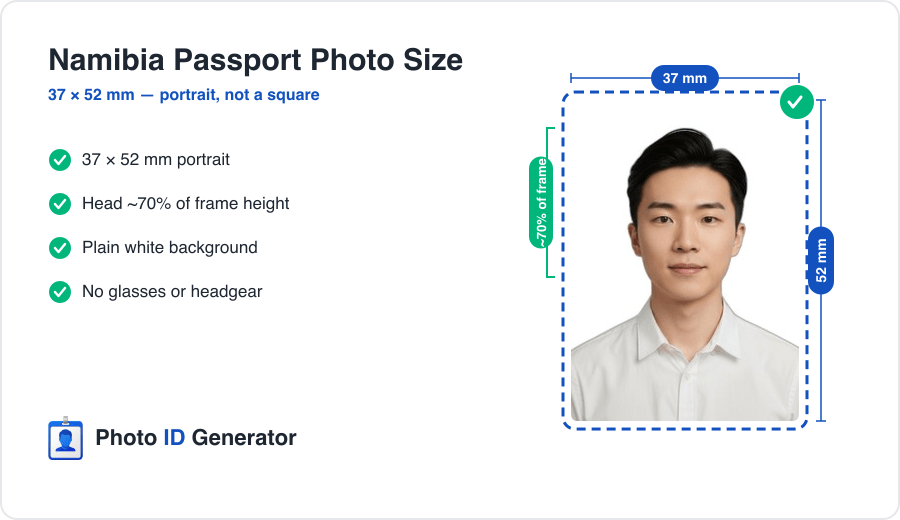
The first thing to get right about a Namibia passport photo is the shape. It is not the 2 × 2 inch square that some tools and services assume — Namibia uses a 37 × 52 mm portrait rectangle, the same tall proportion as the European 35 × 45. Crop to a square and it's the wrong format from the start.
The second thing is that Namibia is unusually strict about what's on your face and head: no glasses, no head gear, no earrings. This guide covers the correct size and the Ministry of Home Affairs rules, with the note that Namibia publishes limited public detail, so some figures are from embassy guidance.
The specification, at a glance
| Specification | Requirement |
|---|---|
| Print size | 37 x 52 mm (portrait, ~1.5 x 2 in) |
| Head height | ~70% of the frame, chin to top of hair |
| Background | Plain white, even, no shadows |
| Glasses | Not allowed |
| Head gear / earrings | Not allowed |
| Photo age | Within the last 6 months |
It's a portrait rectangle, not a square
This is the mistake to avoid. Despite what several photo tools show, Namibia is not a 2 × 2 inch country. The official format is 37 × 52 mm — a portrait rectangle, the same tall shape as most European passports, just slightly larger. A US-style square crop is the single most common format mismatch for Namibia.
Your head should fill roughly 70% of the frame height, chin to the top of the hair, with a small even margin above. Rather than guess the proportion, you can create your Namibia passport photo sized to the correct 37 × 52 portrait with the head positioned for you.
Get the 37x52 portrait right
Upload one photo and get a Namibia-compliant 37x52 mm passport photo — the correct portrait shape and head size on a plain white background, not a 2x2 square.
Namibia's strict "nothing extra" rule
This is where Namibia is tougher than most. The Ministry's guidance removes more than usual:
- No glasses. Eyeglasses are not allowed — take them off for the photo.
- No head gear. Hats and caps are out; the head must be uncovered.
- No earrings or visible piercings, and no uniforms — wear plain, everyday clothing.
The theme is a clean, unadorned face and head: nothing that obscures or distracts from your natural features. Combined with the standard rules, that means a bare face, hair off the forehead and ears, and both eyes clearly visible.
Background, expression, and lighting
Plain white
The background must be plain white, evenly lit, with no shadows behind the head. A clean separation between your face, hair and the backdrop is essential.
Neutral expression
Keep it neutral — no smiling, mouth closed, both eyes open and looking straight at the camera, shoulders square to the frame, ears and forehead not covered.
The print and the move to on-site capture
The printed photo
A 37 × 52 mm colour print on a plain white background, taken within the last six months. Historically you'd bring these prints to a Home Affairs office with your application.
Biometric capture is rolling out
Namibia is moving to on-site biometric capture — the photo (and fingerprints) taken live at Home Affairs offices, with a pilot that began in the Erongo region and is expanding. Where that's in place, your own print may not be needed, but you still want to arrive looking exactly as a compliant photo requires — no glasses, no head gear, plain clothing — because the same standard is applied to the live capture. There's no official online photo-upload portal; the online system is for booking appointments.
One compliant photo, ready either way
We size your photo to Namibia's 37x52 mm spec on white — ready to print, or as a guide for how to present at an on-site capture.
How Namibia compares
Namibia's 37 × 52 mm portrait is close to the European 35 × 45 shape rather than the US square, so a photo framed for the EU is nearly right — but its no-glasses, no-head-gear, no-earrings rule is stricter than most of its neighbours. The shape travels; the strictness doesn't. If you're preparing photos for more than one country, our passport photo tool for 150+ countries applies each country's own size and rules to the same source image.
The short version
A Namibia passport photo is a 37 × 52 mm portrait — not a 2 × 2 square — on plain white, head about 70% of the frame, neutral expression, taken within six months. Then strip everything extra: no glasses, no head gear, no earrings. Get the portrait shape and the bare-face rule right and you've handled what Namibia actually rejects photos for.
Frequently Asked Questions
Need a compliant photo now?
Create a government-ready passport or visa photo in under 60 seconds.
Create My PhotoExplore more content
Nepal Passport Photo Requirements & Guidelines
A Nepal e-passport photo is 35x45 mm on white, but the photo is captured live at enrolment — and a tika on the forehead is a common rejection. Here is what actually matters.
Netherlands Passport Photo Requirements & Guidelines
The Dutch passport photo is checked against an official template (the fotomatrix) with an unusually small 26–30 mm head. Miss the zones and it is rejected. Here is the full spec.

Morocco Passport Photo Requirements & Guidelines
A Morocco passport photo is 35x45 mm, but the tolerances are tight: a 32–36 mm head and a genuinely neutral face. A loose crop or a faint smile is a common rejection.